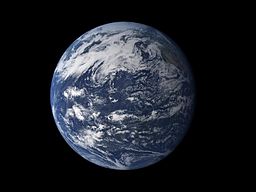
Image Credit: NASA [Public domain], via Wikimedia Commons
What name have they assigned to this most recent batch of kids?
I’m Gen-X; I teach Millennials and Digital Natives. Is this newest crop of prepubescents still considered part of the Digital Native tribe?
I could see that since despite the fact that I programmed dynamic websites for a living during the height of the Internet start-up bubble, my eldest actually schools me on occasion in the functioning of my iPhone, which is just plain embarrassing.
The reason I ask is because of something the almost-7-year-old said today. Any time we run an errand, the chatter in the back seat is almost constant and as long as it’s not arguing I tend to tune it out. Today they were taking turns adding the next sentence to an extended story that started as a riff on Star Wars. I happened to tune back in just in time to hear the little one say: “Well, why don’t we just move to a new planet and call it Earth 2.0?”
Seriously, a first-grader thinks in software versioning terms?
I stumbled across a story about slinkies from the interesting folks at Radiolab the other day. I’m always amazed that a radio program can do an entire show about something as visual as a slinky. Though I guess it shouldn’t surprise me since I spent 6 years getting two high-end degrees writing papers about visual art. But I digress.
So anyway, it turns out that a slinky can do this amazing thing that you wouldn’t expect. When you hold it high off the ground by just a couple of the rings and let it extend to it’s full length, a bit of magic happens when you actually let go of the top. Well, the top does just what you would expect it to do. It starts falling. But the magic part is at the bottom. After you let go of the top, the bottom does…nothing. It just hangs there in mid-air with nothing holding it up while the top of the slinky races toward it.
I’m including below the great video they had at the online version of the show in case you don’t believe me. There’s even a scientist of some sort who was as fascinated by this phenomenon as the story writers and he works out the math and computer model for how this can be physically possible. So here’s the part where my in-between moment happened. As I was watching that computer model it struck me that the physical laws that govern the magic of the non-falling bottom of the slinky are probably the same ones that governed the U.S. housing crash and Great Recession.
Now I like math as much as the next person (well, OK, maybe a little bit more), but definitely not enough to work out proof of this theory. But here’s my reasoning. The computer model shows that the center of mass for the stretched out slinky is way toward the bottom. That’s were most of us in the housing market or general economy are. We rely on whatever’s got the top anchored to keep us from crashing into the ground. We trust that someone else is keeping their eye on that ball because we’re busy down at the bottom making sure bills are getting paid and maintaining the status quo of the bulk of the coils.
In the video you can see as the scientist runs the model forward that from the moment that the top is released the center of gravity actually does start to move downward, but at a sleeping snail’s pace compared to the top section. Something tells me that there were economists or banking experts or regulation gurus somewhere who saw that the top of the economic slinky had been released and probably made loud noises about it, but those of us at the bottom didn’t believe them (if we made time to pay attention to them) because we couldn’t feel anything happening. I mean, we’re seriously busy down here getting things done, right?
So, to the doctoral candidate looking for a dissertation topic, have at that math for me, OK? I’ve got to get to carpool line.
 Thoughts from in between